

Author – Deshna Jain
Intellectual Property refers to an intangible asset that is creation of mind and is subject to the protection of law. In today’s world, where innovation drives economy, IP has become one of the most valuable assets for businesses. IP valuation, in very simple words, means assessing or evaluating its monetary value. With the growing importance of intellectual property, IP assets often account for a significant portion of a company’s overall value, in many cases exceeding the value of tangible assets. IP can be legally enforced, assigned, licensed, and commercially exploited to generate economic benefits. Considering, the ever-increasing role of IP in business growth and innovation, it is essential to understand the concept of IP valuation and its importance in determining the true worth of intellectual assets.
IP VALUATION- WHAT AND WHY?
IP valuation is nothing but evaluating the monetary value of that asset. This is a new concept which is yet emerging especially in developing nations like India. For any asset to be evaluated, context is the pre-requisite, like value can be determined with reference to time, place or any other variable. The value of an IP essentially comes from the right of the owner of that asset has to exclude competitors from using it. For an IP asset to have quantifiable value, it should generate a measurable amount of economic benefits to its owner/user and enhance the value of other assets with which it is associated.[1]
Knowing the value of IP helps across multiple business functions like licensing, franchising, sale or purchase of IP, mergers, acquisitions, divestures, spin-offs, joint ventures or strategic alliances, donation of IP asset and for the purpose of calculation of damages in the case of litigation and enforcement of IP rights. IP valuation is not only beneficial to large corporations and MNCs but also to MSMEs and small but growing companies.
Valuing Intellectual Property Assets, https://www.wipo.int/en/web/business/ip-valuation
PRE-REQUISITES FOR IP VALUATON
For an IP asset to be evaluated, there are certain pre-requisites which are mentioned below:
- It must be separately identifiable (subject to specific identification with a recognizable description- the IP should be able to be isolated from the rest of the business, sold or licensed etc like for example -goodwill of the business cannot be sold independently).
- There should be tangible evidence of the existence of that asset. (for e.g. Contract, registration certificate etc.)
- It should have been created at an identifiable point in time.
- It should be capable of being legally enforced and transferred.
- Its income stream should be separately identifiable and isolated from those of other business assets.
- It should be able to be sold independently of other business assets.
- It must have a finite identifiable lifespan (subject to legal termination i.e.in case of patents, the legal protection given to patents expires after 20 years or destruction by market forces i.e. though trademark can be renewed forever theoretically but its value may differ due to market forces like technological obsolescence, shift in consumer taste etc.).
Valuing Intellectual Property Assets, https://www.wipo.int/en/web/business/ip-valuation
METHODS OF IP VALUATION
The value of the intellectual property can be evaluated using various approaches. There are 3 methods that are said to be used. They are-
- INCOME METHOD-
Income method is the most commonly used and most widely accepted method of IP valuation. It evaluates the value of an IP asset on the basis of amount of economic income that it is expected to generate, adjusted to its present-day value. Income approach is preferred in cases where the asset generation income is positive and its future estimation can be accurately done.
- COST METHOD-
It evaluates the value of an IP asset by calculating the cost of its recreation or by calculating the cost of similar or identical asset. There are two approaches in this method- replacement cost approach and reproduction cost approach. This method is rarely used and is not the most popular method because it doesn’t consider factors like novel or unique characteristics of IP or its unprecedented income generating capacity or risks.
- MARKET METHOD-
As the name suggests, this method involves deriving value with reference to comparable transactions already existing in the market. This method is also known as transactional method. This involves evaluating the value of IP by referring to a comparable transaction, that is price paid by a buyer to purchase similar asset and in similar circumstances. It is most useful when exact comparable transactions are available (for e.g. licensing agreements related to the same technology). This method is dependent on the existence of the such comparable transactions as IP is unique by its definition itself and hence finding transactions that are comparable and under similar circumstances might become a problem.
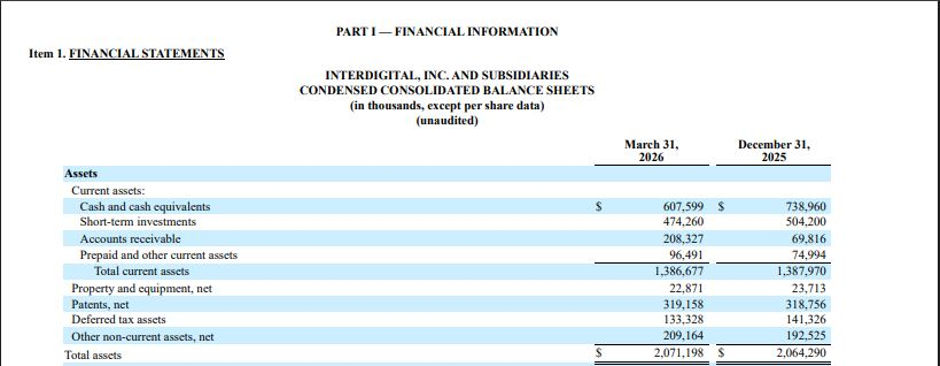
The above figure is an excerpt from Interdigital’s quarterly report, where the company has recognised and reported the value of its patent assets. This serves as an example of how patents can be reflected as valuable intangible assets in financial statements.
CONCLUSION-
As discussed above, IP valuation is an ever-growing concept that plays a crucial role in recognising the true value of intellectual assets. However, its development and adoption in India remain limited due to several challenges such as lack of awareness among businesses, a shortage of skilled valuation experts and the absence of comprehensive legislation and clear valuation guidelines. As innovation and intangible assets continue to drive business growth, it is important for India to strengthen its IP valuation framework. Doing so will help businesses unlock full potential of their intellectual property and contribute to a more innovation driven economy.
Get In Touch
Frequently Asked Questions
IP valuation is the process of determining the monetary value of intellectual property assets such as patents, trademarks, copyrights, designs, and trade secrets.
IP valuation helps businesses understand the commercial worth of their intangible assets for licensing, fundraising, mergers, acquisitions, investment, taxation, and legal enforcement.
Patents, trademarks, copyrights, industrial designs, trade secrets, software, brand names, and other legally protectable intangible assets can be valued.
The three commonly used methods are the income method, cost method, and market method. Each method evaluates IP value from a different commercial perspective.
Startups, MSMEs, large companies, investors, research institutions, and innovators may need IP valuation to make informed business, legal, and investment decisions.