Filing of a patent application in India requires several forms and signatures of inventors, applicant or authorised signatory and attorney/agent. If any one of the forms is not filed, it is considered a valid reason for revocation as well as rejection

E.g., very few applicants know that Form-3 needs to be filed with the
Indian patent office six months after notifying the patent office with the change in the status of the patent application in other countries.
Similarly, every country has its own requirements. Our worldwide associates ensure that all such compliances are done well in time preventing negative repercussions in future. Our team of experts will help you with Indian Patent Filing Procedures in the shortest period of time.
To qualify for registration, a design must:
- Be new and original
- Not have been disclosed anywhere in the world prior to the filing date (or priority date)
- Be significantly distinguishable from known designs
- Be applied to an article capable of industrial manufacture
- Appeal to the eye
- Not be contrary to public order, morality, or security of India
- Not be a mere mechanical contrivance
Exclusions: The following are not registrable:
- Functional or mechanical devices
- Mode or principle of construction
- Buildings or structures
- Literary or artistic works
- Trademarks, labels, tokens
- Mere workshop alterations or common trade variants
- Layout designs of integrated circuits
Step-by-Step Design Registration Process in India 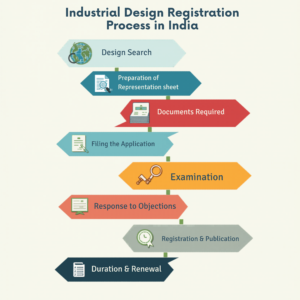
Step 1: Design Search (Recommended): A pre-filing search helps assess novelty and reduces objection risks. Search may be conducted through the official Design database or by filing a formal request before the Design Wing of the Patent Office.
Step 2: Preparation of Representation Sheets: The representation sheet is the most critical document in design filing, as the scope of protection is defined by the visuals submitted.
Step 3: Classification of Design: Designs must be classified under the Locarno Classification System (Third Schedule). The correct class and subclass must be selected based on the nature and function of the article. Incorrect classification may result in objections or delays.
Step 5: Filing the Application: The application may be filed: Through the E-Filing Portal, or Physically at the Design Wing, Kolkata, or branch offices (Delhi, Mumbai, Chennai). Upon filing, an application number is allotted.
Step 6: Examination: The Design Office conducts:
Formal Examination
- Verification of documents
- Compliance with filing requirements
Substantive Examination
- Novelty and originality
- Prior publication check
- Registrability under statutory definition
- Proper classification
- Exclusion criteria review
If objections arise, a First Examination Report (FER) is issued.
Step 7: Response to Objections: The applicant must respond within:
- 6 months from filing date
- Extendable by 3 months upon request. Failure to comply results in abandonment. A hearing may be granted if required.
Step 8: Registration & Publication: Upon acceptance:
- Registration is granted
- An e-Certificate of Registration is issued
- The design is published in the Official Designs Journal
Step 9: Duration & Renewal
- Initial validity: 10 years
- Extendable by additional 5 years
- Renewal must be filed before expiry
Enforcement of Design Rights: Upon registration, the proprietor has:
- Exclusive right to apply the design
- Right to license or assign
- Right to initiate civil action against infringement
Remedies Include:
- Interim and permanent injunction
- Damages or account of profits
- Seizure and delivery-up of infringing goods
Why Choose Brainiac IP Solutions for Industrial Design Filing?
Strategic IP Advisory: We assess novelty, classification, and registrability before filing to minimize objection risks.
Expert Representation Preparation: Precision in preparing compliant representation sheets, novelty statements, and disclaimers.
Accurate Classification Support: Ensuring correct Locarno class selection to avoid procedural hurdles.
Efficient Prosecution Handling: Timely responses to FERs, hearings, and compliance tracking.
International Filing Assistance: Support for convention filings and multi-jurisdictional protection.
Brainiac IP Solutions delivers comprehensive, compliant, and strategically aligned Industrial Design Filing services tailored to innovators, startups, and established enterprises.