

A Complete Guide for Patent Registration in India
Innovation pushes the world forward—but without protection, even the best ideas can be lost or misused. That’s why safeguarding your invention is not just important, it’s necessary.
That’s where a patent comes into the picture. While the patent grants the legal ownership of your invention to the inventor, it also gives them the exclusive right to restrict everyone else to use, make and sell the invention.
But how is a patent obtained?
Let’s understand everything about patent registration in India in this detailed guide, from process to benefits, costs to documents required. Whether you’re an entrepreneur, a researcher, or part of an organisation, this blog aims to simplify the patent registration journey for you.
With the support of a professional firm like Brainiac IP Solutions, the entire process becomes much smoother and stress-free.
Introduction to Patent Registration
A patent is basically a legal document granted by the government to an inventor, which protects the rights and interests associated with the invention. It ensures that others cannot use, sell, or manufacture your invention without your permission. This is a crucial step in protecting your intellectual property, especially for innovators, businesses, and individuals.
Without a patent, your idea can easily be copied by competitors who may not have your background or resources—and you risk losing out on both the financial benefits and the recognition you rightfully deserve.
Registering a patent in India helps you lawfully protect your innovation and gives you the exclusive right to monetise your work.
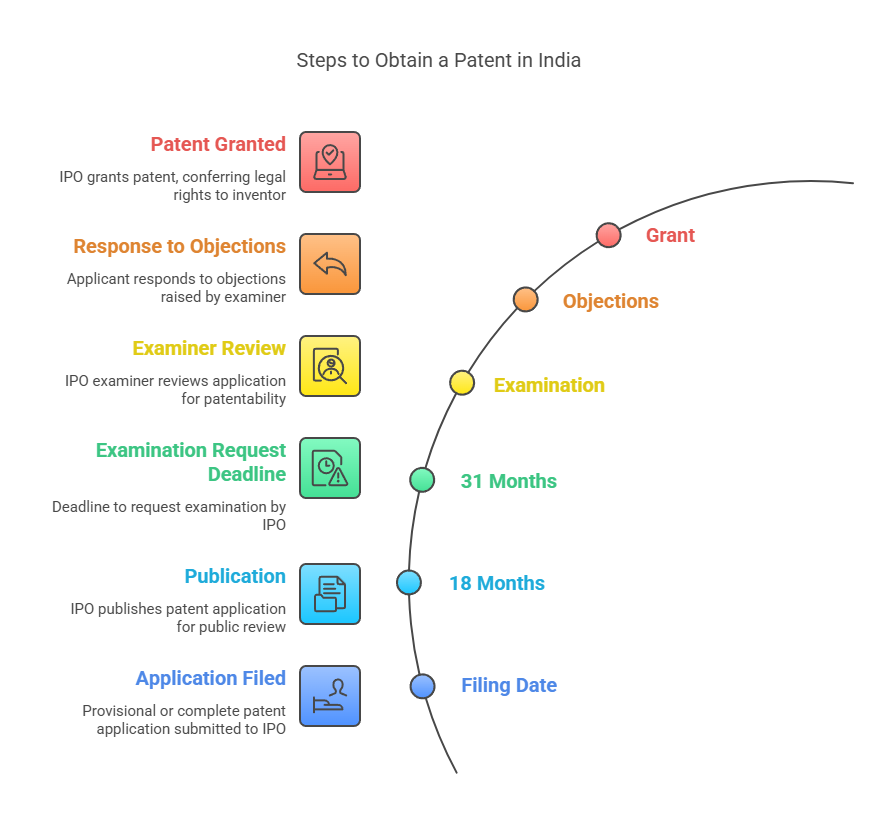
Here’s a step-by-step explanation of how to get a patent in India:
Step 1: Check Patentability
Make sure to check that your invention has novelty, inventive step, and industrial application before applying.
Step 2: Perform a Patent Search
Conducting a thorough patent search helps ensure that your invention is novel and not published anywhere else.
Step 3: Draft a Patent Application
This phase consists of writing a comprehensive description of your invention, which must include:
- Specifications
- Claims
- Visuals: Drawing or Illustration
Step 4: File the Application
File with the Indian Patent Office (IPO) portal or manually at the relevant office. You can file either:
- Provisional Application: A provisional application is the one that does not have the invention claims, it is filed to get a fair amount of time to work on the final/ complete patent application.
- Complete Application: A complete patent application requires full disclosure of the claims, specification and description of the invention and it is filed within 12 months from the date of Provisional Application.
Step 5: Publication
The IPO publishes your patent application 18 months from the date of filing. However, if you wish to speed things up, you can file a request for early publication, which makes your application public much sooner.
Step 6: Examination
Once the application is published, the next step is to request an examination by filing the prescribed form. This must be done within four years from the filing date. After the request is made, the IPO assigns an examiner who thoroughly reviews your application to check if the invention meets the patentability criteria under Indian law.
Step 7: Address Objections
During examination, the IPO may raise certain objections or seek clarifications through an examination report. You’ll be required to respond to these objections with proper justifications or amendments, if necessary, to move the process forward.
Step 8: Grant of Patent
Once all objections (if any) are resolved to the satisfaction of the examiner, the IPO proceeds to grant the patent. This gives you full legal rights over your invention, including the exclusive authority to use, make, sell, or license it.
While the steps may look overwhelming, with Brainiac’s patent registration services, you can be confident that skilled professionals are handling everything on your behalf.
Benefits of Patent Registration
Securing a patent in India offers numerous advantages:
Exclusive Rights: Patents grant you the exclusive right to use, manufacture, and sell the patented invention.
Market Differentiation: Offer a legally protected innovation to distinguish yourself from competitors.
Licensing and Royalties: Licensing your patent can be a source of income.
Legal Protection: Patents provide protection against infringement and unauthorized use.
Investor Appeal: Patents appeal to investors as evidence of innovation and market potential.
When you register your patent with Brainiac IP Solutions, you are not only protecting your idea but you’re also bringing its full potential to life.
The cost for patent in India depends on the applicant type and stages of the process. Here’s an approximate breakdown:
- Filing Fees: INR 1,600–8,000 (individual, startup, or corporate).
- Examination Fees: INR 4,000–20,000.
- Professional Fees: Varies based on the complexity of your invention.
The complete range of expenses can be anywhere between INR 15,000 to INR 60,000 or even over. At Brainiac patent registration, clear pricing structure supplemented with value-added services is offered, ensuring that your investment with us is worthwhile.
Before applying, make sure you have the following documents:
- Patent Specification: A detailed description of the invention.
- Drawings/Diagrams: Visual representations for clarity.
- Applicant Information: Name, address, nationality.
- Form 1: Application for a patent.
- Form 5: Declaration of inventorship.
- Power of Attorney [ Form 26] : If filing through an agent/attorney.
- Priority Documents: If claiming priority from an earlier international application.
Keeping these ready ensures a smooth and efficient filing process.
Time Required for Patent Registration
The patent registration process takes around 2–5 years on average. Here’s why:
- Publication Period: 18 months post-filing.
- Examination Process: Adds additional time based on the backlog at IPO.
If time is of the essence, consider expedited examination, which can significantly reduce the timeline.
What Can and Cannot Be Patented in India?
What Can Be Patented?
- Novel and Sovereign products.
- Applicative processes or methods for industry.
- Machines or devices or apparatus.
- Enhancements to existing products or processes.
What Cannot Be Patented?
- Conceptual ideas and scientific theories.
- Agriculture or horticulture methods.
- Artistic Works (music, art).
- Traditional knowledge or prior art.
Seek expert guidance on patentability with Brainiac IP Solutions, where professionals evaluate whether your invention qualifies for a patent.
How Brainiac is Your One-Stop Solution for Patent Registration
Navigating the patent process can be complex, but with Brainiac IP Solutions, you can rest easy.
Why Choose Brainiac?
- Expert Guidance: We make this a cakewalk for you — error-free applications.
- Full Service: Patentability search, filing and grant — the full spectrum.
- Customized Solutions: Personalized services for individuals, startups, and enterprises.
- Clear Pricing: No hidden costs, just straightforward and fair pricing.
- Time: Move your application along with our optimization.
Brainiac patent registration services for everyone whether an inventor, entrepreneur, researcher, protect your innovation professionally.
Why Choose Brainiac for Your Patent Needs?
Our commitment at Brainiac IP Solutions is to protect your ideas with unrivalled expertise and accuracy. With our wide expertise in patent registration in India, we work through the entire process, so you never have to compromise over hassles throughout the process. Instead, we use our extensive knowledge of IP laws, cost translation, and a client-centric approach to guide you in turning your ideas into protected assets.