Introduction
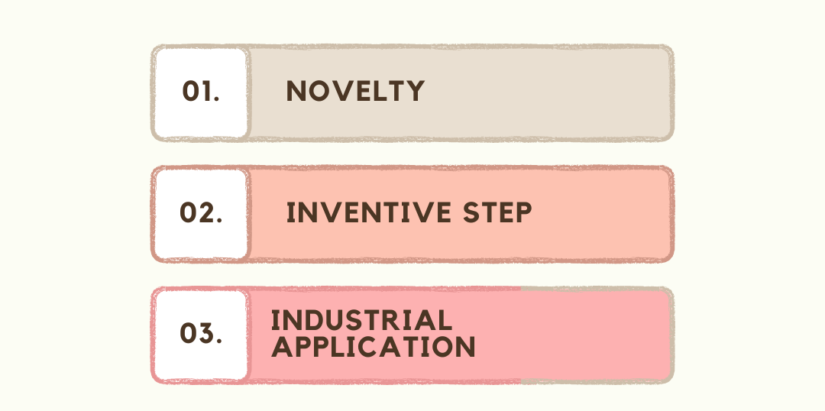
Obtaining a patent is one of the most important steps in the process of safeguarding inventions and encouraging innovative activity. However, not every invention is eligible for a patent because it requires meeting certain conditions. A number of criteria need to be met before a patent can be issued for an invention, the most important of which are novelty, innovative step, and utilisation in industry. The goal of this article is to provide a full knowledge of these patentability criteria by investigating judicial interpretations and the practical ramifications of those interpretations.
1.Novelty
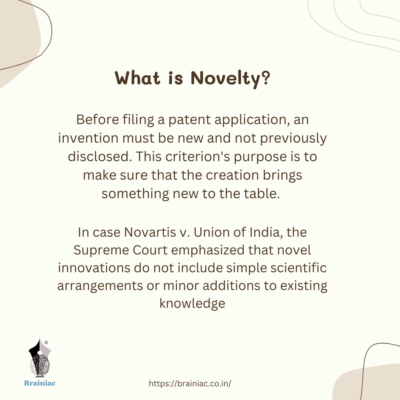 The requirement of novelty is a fundamental requirement for patentability. Before filing a patent application, an invention must be new and not previously disclosed. This criterion’s purpose is to make sure that the creation brings something new to the table. In other words, the idea should not have been published or made available to the public anywhere in the world prior to the filing date of the patent application.
A prior art search is performed to determine novelty. This search entails using various tools and databases to identify existing products or inventions that are related to the proposed invention’s subject matter. This requirement is not met if the invention is simply a refinement or reorganisation of existing elements with no significant innovative aspects.
Judicial Interpretation
The Supreme Court of India emphasised the importance of producing a truly novel and stand-out invention in the case of Novartis v. Union of India. Novel innovations do not include simple scientific arrangements or minor additions to existing knowledge. The court emphasised that inventors must present something distinct and completely new, rather than incremental changes.
Similarly, in CTR Manufacturing Industries Limited v. Sergi Transformer Explosion Prevention Technologies Pt. Ltd, the court ruled that an invention cannot be merely a combination or rearrangement of previously known elements that function independently in a known manner (section 3f). To satisfy the requirement of novelty, the invention must deviate significantly from existing knowledge.
2.Inventive Step
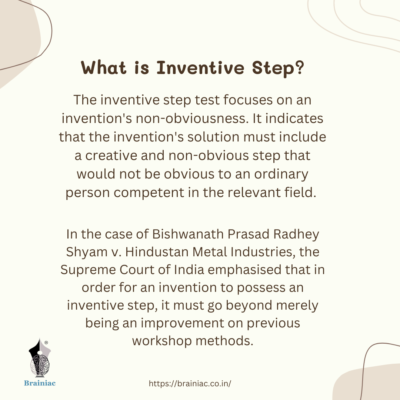 The inventive step test focuses on an invention’s non-obviousness. It indicates that the invention’s solution must include a creative and non-obvious step that would not be obvious to an ordinary person competent in the relevant field. In other words, the invention must not be a simple solution that a trained professional would naturally devise based on existing knowledge and prior art.
Assessing the ‘inventive’ step involves deciding whether the intended invention represents a significant advancement over what is currently known in the industry. If the answer looks obvious to someone with expertise in the field, it does not meet the criteria of an inventive step.
Judicial Interpretation
In the case of Bishwanath Prasad Radhey Shyam v. Hindustan Metal Industries, the Supreme Court of India emphasised that in order for an invention to possess an inventive step, it must go beyond merely being an improvement on previous workshop methods. Even in the case of patents for improvements, the improvements themselves need to display some level of innovative inventiveness.
In the United States, a person of ordinary skill in the art (also known as POSITA) is used to judge whether or not something is evident based on their point of view. The invention cannot be something that a typical knowledgeable individual working in the field would naturally think of by making use of the information that already exists in the field.
3.Industrial Application
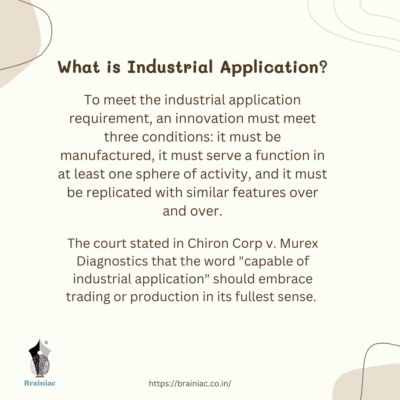 An important factor for patentability is industrial application, which ensures that an invention has practical utility and can be used in real-world circumstances. To meet the industrial application requirement, an innovation must meet three conditions: it must be manufactured, it must serve a function in at least one sphere of activity, and it must be replicated with similar features over and over.
The industrial application requirement is intended to prevent patents from being granted for abstract or purely theoretical concepts that cannot be implemented in real contexts. An invention should not be just intellectual or devoid of real-world application. It should be useful and capable of being employed in industries or commercial operations.
Judicial Interpretation
The court emphasised in the F. Hoffman-La Roche decision that the requirement of industrial application requires an innovation to have commercial use. A patent can only be granted if the invention has some commercial value, even if it is not in its final form. The emphasis is not just on the product itself, but also on its commercialization possibilities.
The court stated in Chiron Corp v. Murex Diagnostics that the word “capable of industrial application” should embrace trading or production in its fullest sense. Furthermore, the invention must have the potential for profit, as enterprises would not use something that is not beneficial or practical.
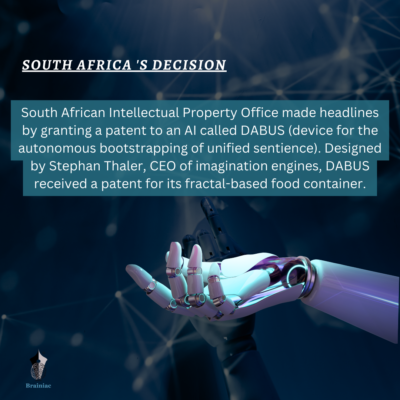 Despite the criticism from around the world, the decision made by the South African IP office is in line with the laws that are already in place in the country’s government as well as the aim of encouraging innovation. Notably, 2018 saw the beginning of patent reform in South Africa, which was highlighted by the implementation of the Intellectual Property Policy Phase I. After then, a number of additional key policy instruments were released, each of which placed an emphasis on the significance of science, technology, innovation, and the coming of the fourth industrial revolution.
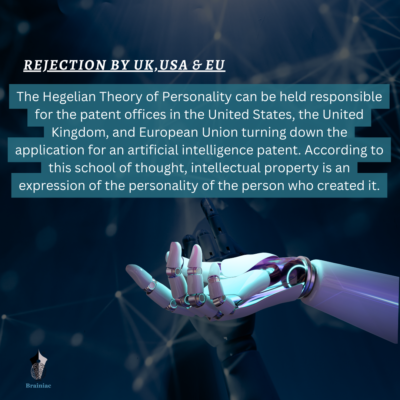 The Hegelian Theory of Personality can be held responsible for the patent offices in the United States, the United Kingdom, and European Union turning down the application for an artificial intelligence patent. According to this school of thought, intellectual property is an expression of the personality of the person who created it. The regulations governing patents in these areas declare unequivocally that they are only applicable to human inventors. They place an emphasis on the requirement of “mental conception,” which is thought to be a capacity that is unique to the human mind. In addition to this, the rights of inventor ship can only be granted to human beings.
 Form 1 of the Patents Act contains application 3B, which allows the applicant to be a natural or non-natural person, such as a small business, a startup, or another entity. The term ‘other’ is highly interpretable and can be used in a variety of contexts not mentioned precisely.
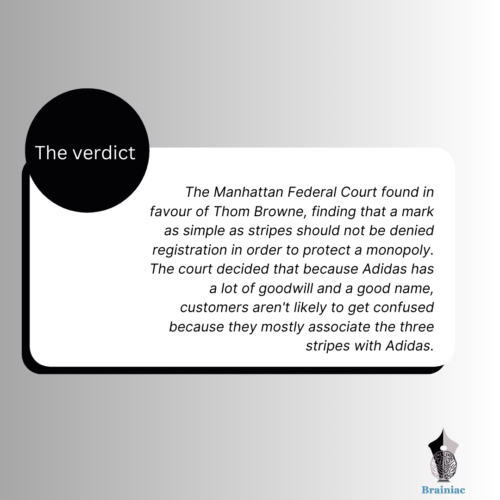
 The dispute between Adidas and Thom Browne can be traced back to 2007, when Browne made a jacket with three stripes, which prompt Adidas to file a for a trademark infringement suit. Browne later made changes and added one more stripe to his trademark to deal with the problem. But things got worse again when Adidas saw Browne’s four-striped design. Adidas tried to negotiate with Browne, but they were not successful. Later, in 2021 Adidas filed a trademark infringement lawsuit against Browne. The company said that Browne’s Four-Stripe design could trick and confuse customers and was a threat to Adidas’ Three-Stripe Mark, which has been a symbol of the brand since 1952.