

Introduction
A trademark is a distinctive sign or indicator used by an individual or an organization to identify their goods or services from those of others. Trademarks can be words, phrases, symbols, designs, or a combination of these elements.
Trademarks are indispensable for establishing brand identity and are crucial for entities. In India, as well as globally, entities are increasingly focused on protecting their trademarks and brand names. The trademark landscape in India is evolving, prompting individuals and organizations to go to great lengths to safeguard their goods from imitation.

II. Origin and Evolution of Trademark Law in India
A. Pre-1940: Common Law Principles
Before 1940, India lacked statutory trademark laws, relying on common law principles of equity and passing off to protect trademarks.
B. The Trademark Act of 1940
The Trademark Act of 1940 was enacted as the first statutory law in India for trademark registration and protection. It aligned closely with English laws and precedents.
C. The Trade & Merchandise Marks Act, 1958
Due to increasing trade and commerce, the Trade & Merchandise Marks Act, 1958 replaced the Trademark Act of 1940. It aimed to enhance trademark protection and consolidate provisions from other statutes.
D. Adoption of TRIPS and the Trademark Act, 1999
To comply with Trade-Related Aspects of Intellectual Property Rights (TRIPS) and accommodate globalization, the Trademark Act, 1999, and Trademark Rules, 2002 were introduced. These regulations became effective on September 15, 2003, and introduced provisions for service trademarks, well-known marks, and the establishment of the Intellectual Property Appellate Board (IPAB).
E. The Trademark (Amendment) Act, 2010
The Trademark (Amendment) Act, 2010 incorporated provisions related to international trademark registration under the Madrid Protocol. This amendment expanded the scope of Indian trademark law to cover both national and international registrations.
III. Functions of Trademarks
Trademarks serve multiple essential functions in the realm of intellectual property rights, including:
- Exclusive Right: Granting exclusive rights to the trademark owner to use the mark for identifying their goods or services.
- Fraud Prevention: Preventing fraudulent use of the mark by unauthorized parties.
- Legal Proceedings: Empowering trademark owners to initiate legal proceedings against trademark infringement.
- Passing Off: Providing protection to unregistered trademarks under the common law principle of passing off.
- Prevention of Unfair Competition: Safeguarding against the use of similar or deceptively similar marks by unfair competitors.
- Protection of Intellectual Property: Preserving the skill and intellect of companies.
IV. Current Framework: Trademark Act, 1999 and Trademark Rules, 2017
Presently, the primary legislation governing trademarks in India is the Trademark Act, 1999, along with the Trademark Rules, 2017. These regulations outline the procedural aspects of trademark filing, examination, publication, opposition, registration, renewal, rectification, and removal. The Controller General of Patents, Designs, and Trademarks (CGPDTM), operating under the Department of Industrial Policy and Promotion (DIPP), Ministry of Commerce and Industry, oversees the trademark system in India.
V. The Trademark Registration Process
Trademark registration involves a step-by-step process that encompasses various stages, each with its own procedural requirements and documentation. The key stages include:
- Trademark Search: Conducting a comprehensive search to assess the availability and uniqueness of the proposed mark.
- Trademark Filing: Submitting a trademark application, including the necessary details and supporting documents.
- Examination and Publication: The trademark application undergoes examination by the trademark office, and if accepted, it is published for public opposition.
- Opposition Proceedings: Parties can oppose the registration of a trademark during a specific period after its publication.
- Registration and Renewal: If there are no oppositions or they are successfully resolved, the trademark is registered, and subsequent renewals are required to maintain the registration.
- Rectification and Removal: The trademark can be rectified or removed from the register based on certain grounds and procedures.

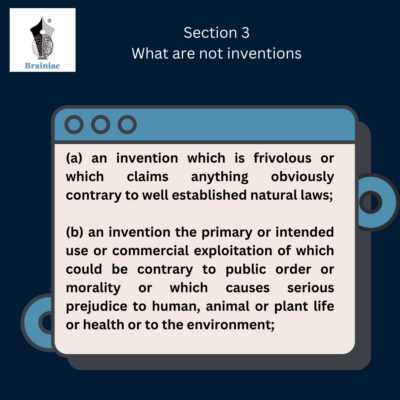 This clause states that inventions that are frivolous or clearly contradict well-established natural rules are not patentable. This rule ensures that patents are not granted for inventions that do not represent significant technological progress or are based on pseudoscience. A perpetual motion machine, for example, that claims to generate infinite energy without any external input would fall into this category.
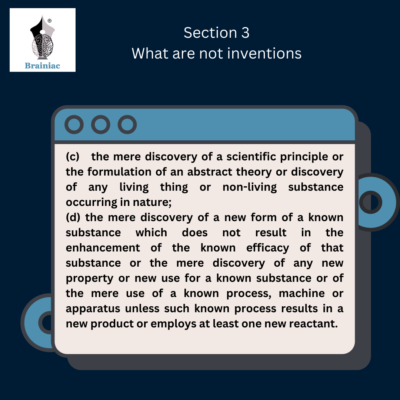 Simple discoveries of scientific concepts or the development of abstract hypotheses are not patentable under this provision. Inventions involving the discovery of a live item or a non-living substance in nature are also prohibited. For example, under this rule, the discovery of a specific DNA sequence identified in a certain plant species would not be patentable.
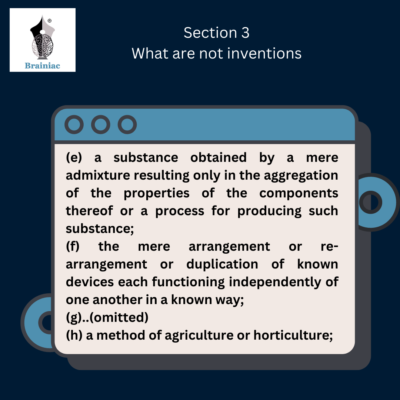 A substance obtained by a simple mixing resulting in the aggregation of the qualities of its components, or a process for making such a material, is not patentable. In other words, a combination of existing substances cannot be patented if it does not result in a novel product with improved features or advantages. A blend of two known substances, for example, that does not demonstrate any novel or unexpected features would not be patentable.
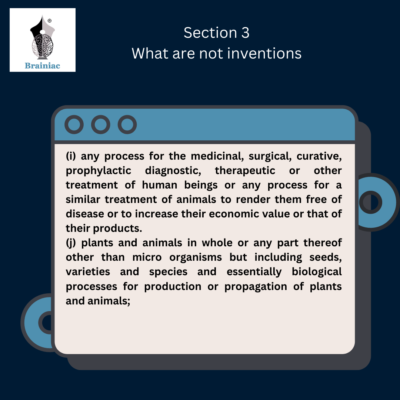 This provision forbids the patenting of procedures for the treatment of humans or animals in order to cure them of disease or raise their commercial value. Processes for medical, surgical, curative, prophylactic, diagnostic, therapeutic, or similar therapies are excluded. A specific surgical procedure to remove cataracts, for example, or a treatment method for cancer would not be patentable.
 This provision prohibits the patentability of mathematical or business procedures, computer programmes as separate things, and algorithms. However, if these methods or programmes are combined with a technical application that gives a technical solution to a problem, they may be patentable.