
Author: Hemant Goyat
Introduction:
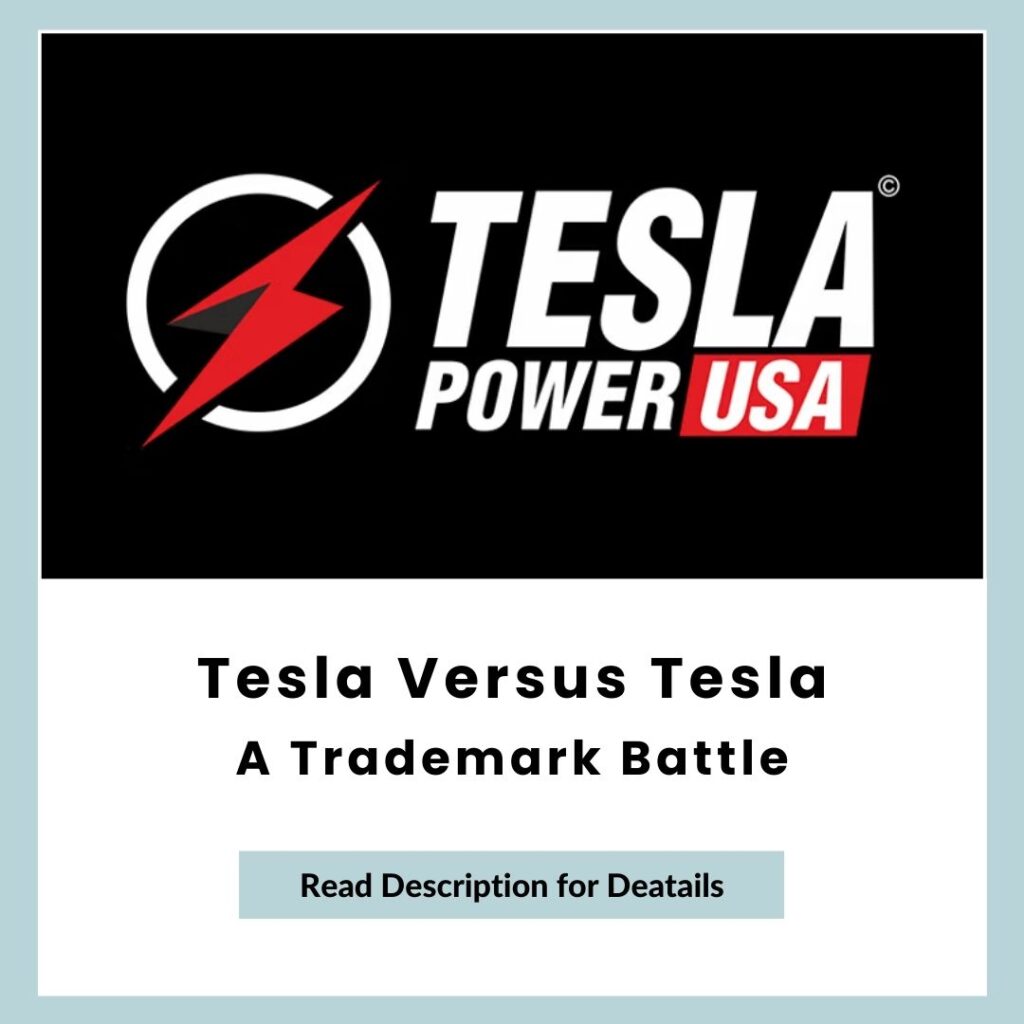
The Delhi High Court recently passed a judgement in favour of Tesla Inc. in the trademark infringement case against Tesla Power. The suit against the Defendants, Tesla Power India Private Limited & Ors. was instituted over the use of the marks Tesla Power, Tesla Power USA, and similar logos like and , including the domain names www.Teslapowerusa.ae, www.Teslapower.in, www.teslapower.com, www.Teslahealthylife.com.
Background:
The present dispute arose from a trademark infringement and passing off action instituted by Tesla Inc., a globally renowned company engaged in the field of electric vehicles and clean energy solutions, against Tesla Power India Private Limited.
Tesla Inc. asserted that it is the prior adopter, user, and registered proprietor of the mark “TESLA” in several jurisdictions across the world and that the mark has acquired the status of a well-known trademark on account of long, continuous, and extensive use.
Submissions made by Plaintiff:
- Infringement and passing off-
The Defendants were alleged to have infringed and passed off the Plaintiff’s trademark by using and applying for the marks “TESLA POWER” and “TESLA POWER USA” bearing application nos. 4855017 and 4855802 under Class 9.
- Actions taken by the Plaintiff-
The Plaintiff asserted that the actual confusion arose when the Defendants announced their entry into the electric vehicle business in December 2021. The Plaintiff thereafter issued a cease-and-desist notice on 18 April 2022 seeking cessation of use and withdrawal of the impugned marks.
- Defendant’s ignorance-
The Plaintiff has argued that in March 2023, the Defendants published a full page advertisement in The Times of India announcing the launch of electric two-wheelers using an American technology and claiming a Pan India sales and Service Network, which prompted the Plaintiff to institute the present suit.
Submissions made by Defendant:
- Adoption inspired by Nikola Tesla-
The defendants contended that the adoption of the marks was inspired by the scientist Nikola Tesla and was made in good faith, without any intent to mislead or infringe.
- No exclusive rights-
The defendants argued that the Plaintiff has wrongly claimed exclusivity over the mark “TESLA”, which is common to trade and widely used by third parties. They further submit that “TESLA” is a common surname associated with the scientist Nikola Tesla and that no single entity, including the Plaintiff, can claim exclusive rights over it.
- Delay in filing suit-
The defendants pointed out a delay of over two years in the Plaintiff’s filing of the suit, during which their business had grown substantially.
- Plaintiff’s lack of reputation and goodwill-
The defendants submitted that the Plaintiff relies only on a promotional activity in 2010 to claim use in India. They contended that such casual, intermittent, and experimental use is insufficient to establish reputation or secondary meaning.
- Distinctiveness in goods-
The defendants asserted that their products like lead-acid batteries and inverters are fundamentally different from the Plaintiff’s electric vehicles and battery systems, with distinct trade channels and customer bases. They further argue that batteries do not constitute structural automobile parts under Class 12, and that lead-acid batteries are technologically and commercially distinct from electric vehicle battery systems.
Judgement:
- Trademark Infringement-
The Court found that Tesla Inc.’s registered marks in Class 9 cover inverters, and the defendants’ use of “TESLA POWER” and “TESLA POWER USA” for similar products amounts to clear infringement.
- Goodwill and Reputation-
Tesla Inc. has established strong goodwill and global recognition, supported by media coverage, revenue, and the popularity of its CEO. The defendants’ use of the marks was prima facie dishonest.
- Likelihood of Confusion & Passing Off-
Actual confusion was observed among consumers and media, and the addition of terms like “POWER” or “USA” does not prevent it. Allowing the defendants to use the marks could harm the plaintiff’s reputation.
- Defendants’ Arguments Rejected-
Claims that “TESLA” is generic, common to trade, or co-used by third parties were dismissed.
- Interim Relief Granted-
The Court held that the Plaintiff and Defendants’ marks, products, trade channels, and consumer base are effectively identical. Accordingly, an interim injunction was granted restraining the Defendants from manufacturing, marketing, or advertising EVs under the impugned marks until the suit’s final disposal.
Get In Touch
FAQ
1. What was the dispute between Tesla Inc. and Tesla Power India?
Tesla Inc. filed a trademark infringement and passing off suit against Tesla Power India for using the names “TESLA POWER”, “TESLA POWER USA” and similar domains and logos that could mislead consumers into believing an association with Tesla Inc.
2. Why did Tesla Inc. object to the use of “TESLA POWER”?
Because “TESLA” is a registered and well-known trademark of Tesla Inc. globally. The use of a confusingly similar name for related products (like batteries and EV-related goods) can mislead consumers and dilute Tesla’s brand.
3. Is adding words like “Power”, “USA”, or “India” enough to avoid infringement?
No. The Court clearly held that adding descriptive words does not eliminate confusion when the dominant part of the mark (“TESLA”) remains identical.
4. Can someone use a famous name if it is inspired by a historical figure like Nikola Tesla?
Not when the name has acquired strong trademark significance. The Court rejected the argument that inspiration from Nikola Tesla justifies commercial use when it causes consumer confusion with an existing famous brand.
5. Did the Court accept the argument that “TESLA” is a common or generic word?
No. The Court rejected the claim that “TESLA” is generic or common to trade and confirmed that it enjoys strong distinctiveness and global recognition.
