
Introduction
Large Language Models (LLMs) like ChatGPT are trained on large-scale datasets containing publicly available information. In this process, the use of copyrighted material for AI training raises critical copyright law questions.
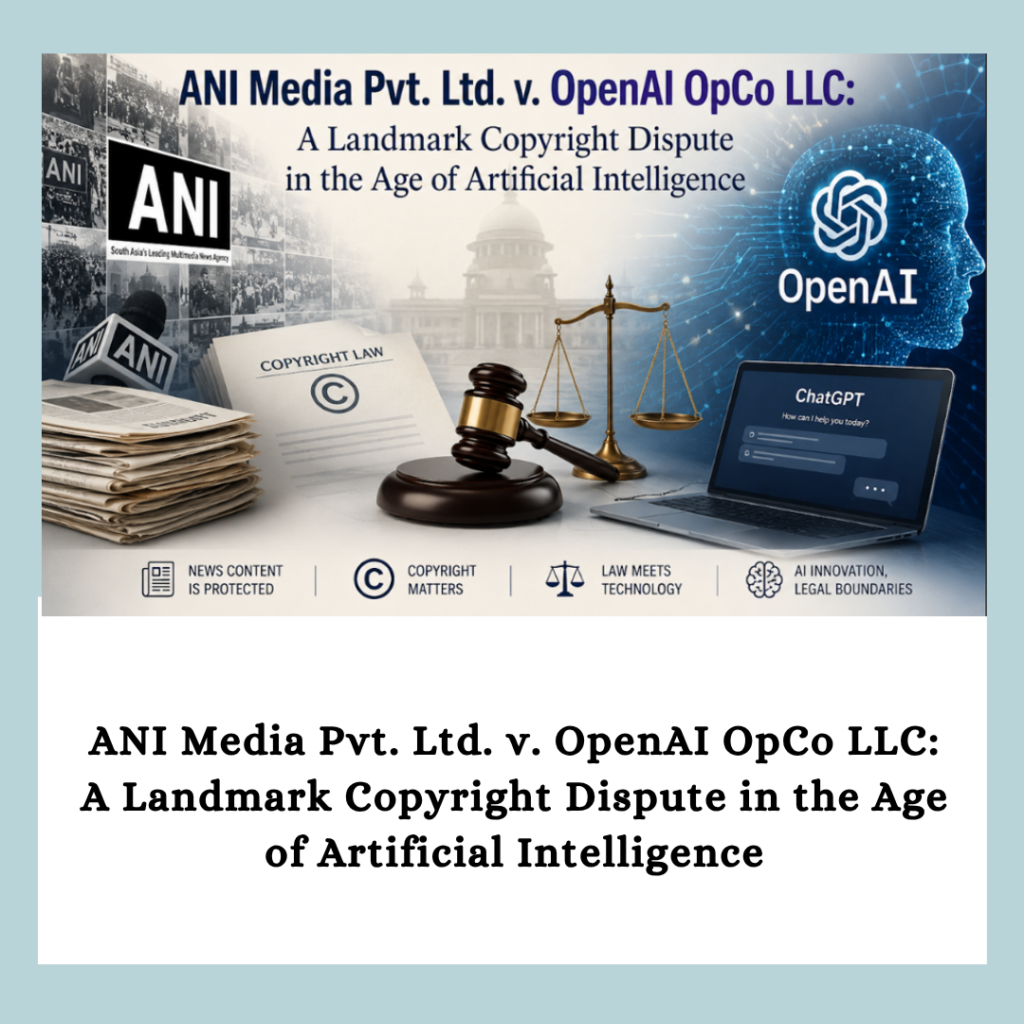
ANI Media Pvt. Ltd. v. OpenAI OpCo LLC is one of the significant copyright disputes in India examining the alleged unauthorised use of copyrighted news content for training large language models.
The case concerns whether the use of copyrighted news content for training AI constitutes copyright infringement and the extent to which copyright law can govern the use of copyrighted material during AI training.
Background
ANI Media Pvt. Ltd. (ANI) is a leading news company publishing news reports, photographs, videos and other journalistic content. The company has invested in producing news content protected under the Copyright Act, 1957.
OpenAI OpCo LLC is an artificial intelligence company associated with the development of ChatGPT, an AI chatbot capable of generating responses based on data and patterns on which its models have been trained.
ANI alleges that OpenAI used its copyrighted news content for training its AI models without permission and that ChatGPT can reproduce ANI's news reports, including allegedly reproducing certain content verbatim.
ANI approached the Delhi High Court alleging copyright infringement and claiming that unauthorised use of its content for AI training could adversely affect its licensing revenue and the commercial value associated with its journalism.
Legal Issues
Whether the use of copyrighted content for training AI constitutes copyright infringement.
Whether reproduction or storage of copyrighted works during AI training constitutes infringement.
Whether content produced by an AI chatbot constitutes copyright infringement.
Whether the dispute falls within the jurisdiction of the Delhi High Court.
Whether the use of publicly available copyrighted material for AI training falls under statutory exceptions to copyright infringement.
Arguments of the Parties
- ANI's news reports and journalistic content are protected by copyright.
- OpenAI allegedly used ANI's content for AI training without permission or licence.
- ANI argues that such use constitutes copyright infringement.
- ANI alleges that ChatGPT can reproduce its copyrighted content verbatim.
- Such use may diminish the commercial value of ANI's licensed content.
- AI developers should not commercially benefit from copyrighted works without permission.
- ChatGPT is not merely a database of stored articles.
- AI models learn statistical patterns in language.
- ChatGPT generates responses rather than simply reproducing copyrighted material.
- OpenAI disputes that AI training itself constitutes copyright infringement.
- Issues concerning jurisdiction and applicability of the Copyright Act also require consideration.
Relevant Statutory Provisions
Section 13 – Subject Matter of Copyright
Section 13 provides the categories of works in which copyright subsists, including original literary, dramatic, musical and artistic works.
Section 14 – Meaning of Copyright
This provision provides copyright owners with specified exclusive rights, including the right to reproduce a protected work.
Section 51 – Copyright Infringement
Section 51 addresses circumstances in which acts involving rights reserved to a copyright owner may constitute infringement when carried out without authorisation.
Section 52 – Exceptions to Infringement
Section 52 provides circumstances in which specified uses of copyrighted works do not constitute copyright infringement, including certain fair-dealing exceptions.
Proceedings Before the Delhi High Court
The Delhi High Court has heard arguments concerning preliminary questions including maintainability and jurisdiction. The Court has also considered the wider implications of the dispute for copyright law and artificial intelligence.
The dispute raises significant questions extending beyond the immediate parties because its outcome may have consequences for technology developers, media companies, copyright owners and the development of copyright law in relation to AI.
Analysis
The dispute between ANI and OpenAI highlights the emerging tension between copyright protection and generative artificial intelligence.
From the copyright owner's perspective, unauthorised use of protected content during AI training may amount to exploitation of copyrighted works and may potentially affect their economic value.
AI developers, on the other hand, argue that model training involves analysis and learning from statistical patterns rather than conventional reproduction of copyrighted works.
The case therefore raises important questions about whether copying undertaken during the technical process of AI training falls within the exclusive rights provided under copyright law, whether statutory exceptions apply, and when an AI-generated output may potentially infringe an existing copyrighted work.
Potential Impact
The ANI v. OpenAI dispute may have implications for multiple stakeholders operating at the intersection of technology, media and intellectual property.
AI Copyright Disputes
It may influence future copyright disputes involving artificial intelligence.
Licensing Practices
It may influence licensing practices between AI developers and copyright owners.
Future Litigation
It may provide guidance for similar AI-related copyright litigation in India.
AI Regulation
The case may contribute to the development of India's regulatory landscape for artificial intelligence.
Conclusion
ANI Media Pvt. Ltd. v. OpenAI OpCo LLC is an important ongoing copyright dispute concerning the alleged unauthorised use of news content for training artificial intelligence systems.
The litigation raises fundamental copyright questions, including whether the use of copyrighted material during AI training constitutes infringement and how provisions of the Copyright Act, 1957 apply to AI-generated content.
The judicial determination may provide important guidance to AI developers, media companies, copyright owners, policymakers and other stakeholders regarding the use of copyrighted works for artificial intelligence development in India.
Have Questions About Intellectual Property?
Connect with our team to discuss patents, copyrights, trademarks, IP strategy, AI-related intellectual property issues, or other IP requirements.
